
 Schweiz
Requirements for Aerodromes for the Main Flying Disciplines
Martin Andreas K. Facts checked Jonas Felix H.
Flight competitions combine piloting skills, technical precision and strategic planning. Depending on the discipline, pilots compete in aerobatics, speed, navigation or landing accuracy. Organising these competitions requires suitable airfields and infrastructure tailored to the specific requirements of each event. The necessary facilities and scoring criteria vary from one discipline to another.
The Main Disciplines in Air Sports
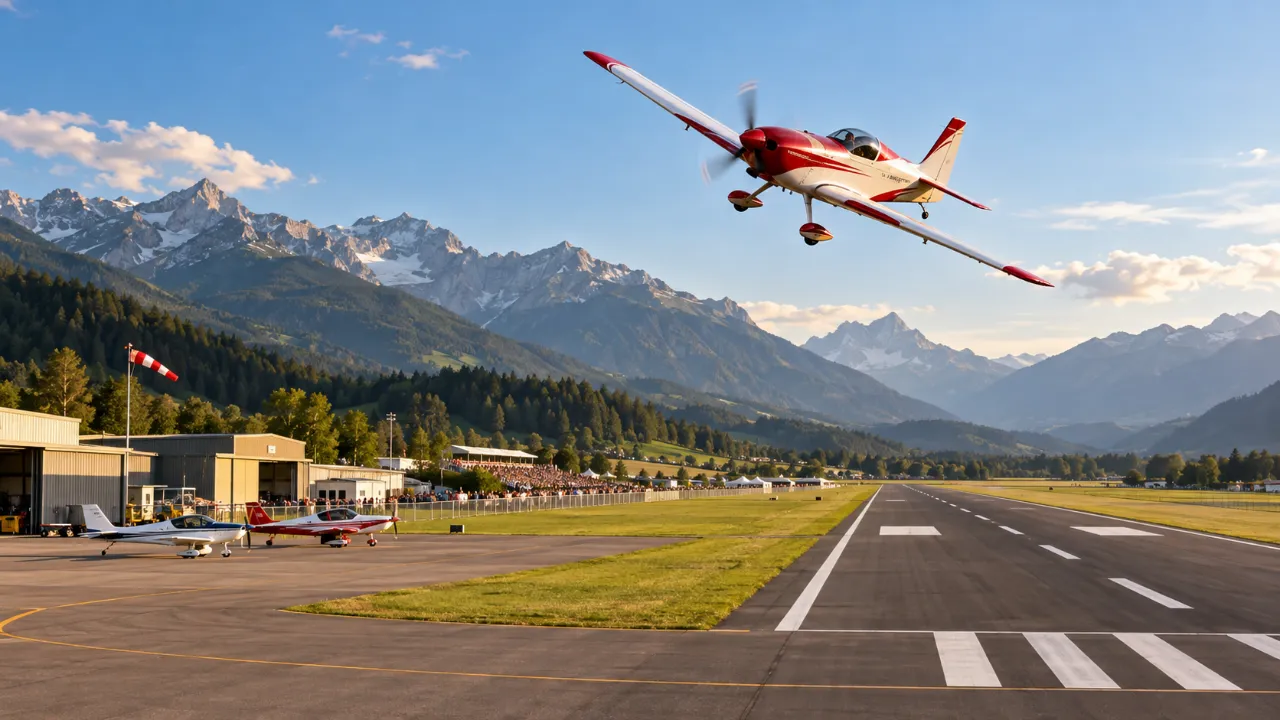
Air sports include various types of competitions in which pilots compete using manned aircraft. While some disciplines focus on the technical execution of flight manoeuvres, others emphasise speed, navigation or precision. As a result, both the scoring criteria and the requirements for the airfield differ depending on the type of competition.
Aerobatics
In aerobatic competitions, pilots perform a series of prescribed figures and demanding manoeuvres in a specified sequence. Specially designed aerobatic aircraft are used to perform rapid changes of direction, rolls, loops and other figures. The key criteria are technical execution, precision and compliance with the competition programme. Airfield requirements and scoring:
- Runway: A suitable runway and sufficient space for the safe operation of the aircraft involved.
- Airspace: A designated area large enough for aerobatic manoeuvres, free from prohibited obstacles and conflicts with other air traffic.
- Safety zones: Restricted areas for spectators and suitable locations for the judges.
- Scoring system: Assessment of individual figures based on execution, precision, spatial orientation and compliance with the prescribed sequence.
- Penalties: Incorrectly performed, incomplete or omitted figures may result in points being deducted.
Scoring depends on the competition category and the applicable regulations. Judges assess individual figures according to established criteria, and the overall score is calculated from the points awarded and any deductions applied. Depending on the format, several rounds or different programmes may contribute to the final ranking.
Air Racing
In air racing, pilots compete to complete a predefined course as quickly as possible. Depending on the competition, they may fly a circuit or pass designated turning points and checkpoints. In addition to speed, precise adherence to the racecourse and safe aircraft handling are essential. Airfield requirements and scoring:
- Runway: A runway suitable for the participating aircraft types, with adequate safety margins.
- Racecourse: A clearly defined course with marked turning points or other checkpoints.
- Safety areas: Sufficient separation between spectator zones, buildings and other obstacles.
- Timekeeping: Reliable recording of lap times, completion times and finishing order.
- Rule enforcement: Monitoring compliance with the prescribed flight route and recording any violations or penalties.
Depending on the format, the final ranking is determined by completion time or finishing order. Time penalties and violations of course rules can affect the result. When analysing performance, it is therefore important to consider not only aircraft performance and previous results, but also the course layout, weather conditions and the specific race format.
Precision Flying
Precision flying competitions focus on completing navigation tasks, meeting time requirements and performing landing manoeuvres as accurately as possible. Participants generally fly light aircraft with engines and must carefully prepare their routes before take-off. Rather than achieving the highest speed, the objective is to complete the tasks with as few errors as possible. Airfield requirements and scoring:
- Runway: A suitable runway that allows precision landings to be performed safely.
- Landing area: Depending on the regulations, designated markings or a specially arranged area for assessing landing accuracy.
- Preparation facilities: Suitable rooms for briefings, map reading and preparation for navigation tasks.
- Timekeeping: Facilities for recording departure times, time deviations and other relevant data.
- Scoring system: Penalty points for navigation errors, deviations from the schedule, incorrectly identified checkpoints or inaccurate landings.
Results are generally calculated using a penalty-point system: the more mistakes a team makes, the worse its score. The winner is normally the participant with the lowest total number of penalty points after completing all tasks. The precise weighting of individual tasks depends on the regulations of the relevant championship.
Navigation and Rally Flying
In navigation and rally flying competitions, participants must follow a prescribed route using maps, waypoints and other navigational clues. In many rally formats, a pilot and a navigator work together as a team. In addition to navigational skills, careful flight planning and adherence to time requirements are essential. Airfield requirements and scoring:
- Starting and finishing airfields: A suitable airfield for the start and finish of the competition, as well as for team preparation.
- Route planning: Defined routes with checkpoints and, where applicable, tasks involving the identification of ground features.
- Timekeeping: Recording passage times and deviations from specified time windows.
- Documentation: Facilities for evaluating checkpoints, navigation tasks and other competition data.
- Scoring: Penalty points for incorrect routes, missed checkpoints, timing deviations or incorrect answers in additional tasks.
Results are based on navigational accuracy and the successful completion of the other competition tasks. Depending on the regulations, timing deviations, missed checkpoints and other errors may carry different penalties. When preparing for a competition, it is therefore important to consider the participants' flying experience, familiarity with the route and the complexity of the tasks.
What Infrastructure Do Flight Competitions Require?
The requirements for an airfield depend on the discipline, the aircraft involved and the competition regulations. Not every event requires a large commercial airport: many competitions can be held at a suitable airfield with an appropriate runway and the necessary safety measures. In Switzerland, for example, national aerobatic championships held at Bressaucourt Airfield demonstrate that specialised airfields can serve as venues for such events. General infrastructure requirements include:
- Runway: Its length, width, surface and condition must be suitable for the aircraft involved.
- Aircraft parking and hangars: Sufficient space for aircraft, technical inspections and, where necessary, minor maintenance work.
- Safety arrangements: An emergency plan, appropriate rescue and firefighting equipment, and secured spectator areas where required.
- Communications and air traffic control: Air traffic coordination, radio communications and any necessary airspace clearances.
- Competition facilities: Rooms or designated areas for briefings, judging, timekeeping, results processing and administrative tasks.
- Services and access: Depending on the duration and scale of the event, facilities for refuelling, catering and access for participants and spectators.
The actual facilities required must be determined according to the competition format and applicable regulations. For aerobatics and air racing, for example, airspace safety and the separation of spectator areas are particularly important. In precision and navigation flying, the preparation and evaluation of competition tasks play a greater role. An airfield therefore does not need to be as large as possible; it needs to be suitable for the specific discipline and organised safely.
Betting on Flight Competitions
Betting on flight competitions is a niche market, and the available options vary depending on the bookmaker and the event. Where betting markets are offered, possible options may include betting on the overall winner, the placement of individual pilots or the outcome of a specific race. The availability of these markets should be checked with each provider, as not all flight disciplines are regularly included in betting offerings.
A sound analysis should take into account previous results, pilots' experience, aircraft performance data and the characteristics of the course. Weather conditions, competition regulations, potential penalties and the reliability of available statistics should also be considered. Data is often limited in less widely followed disciplines, so predictions should be treated with appropriate caution.